Seakeeping

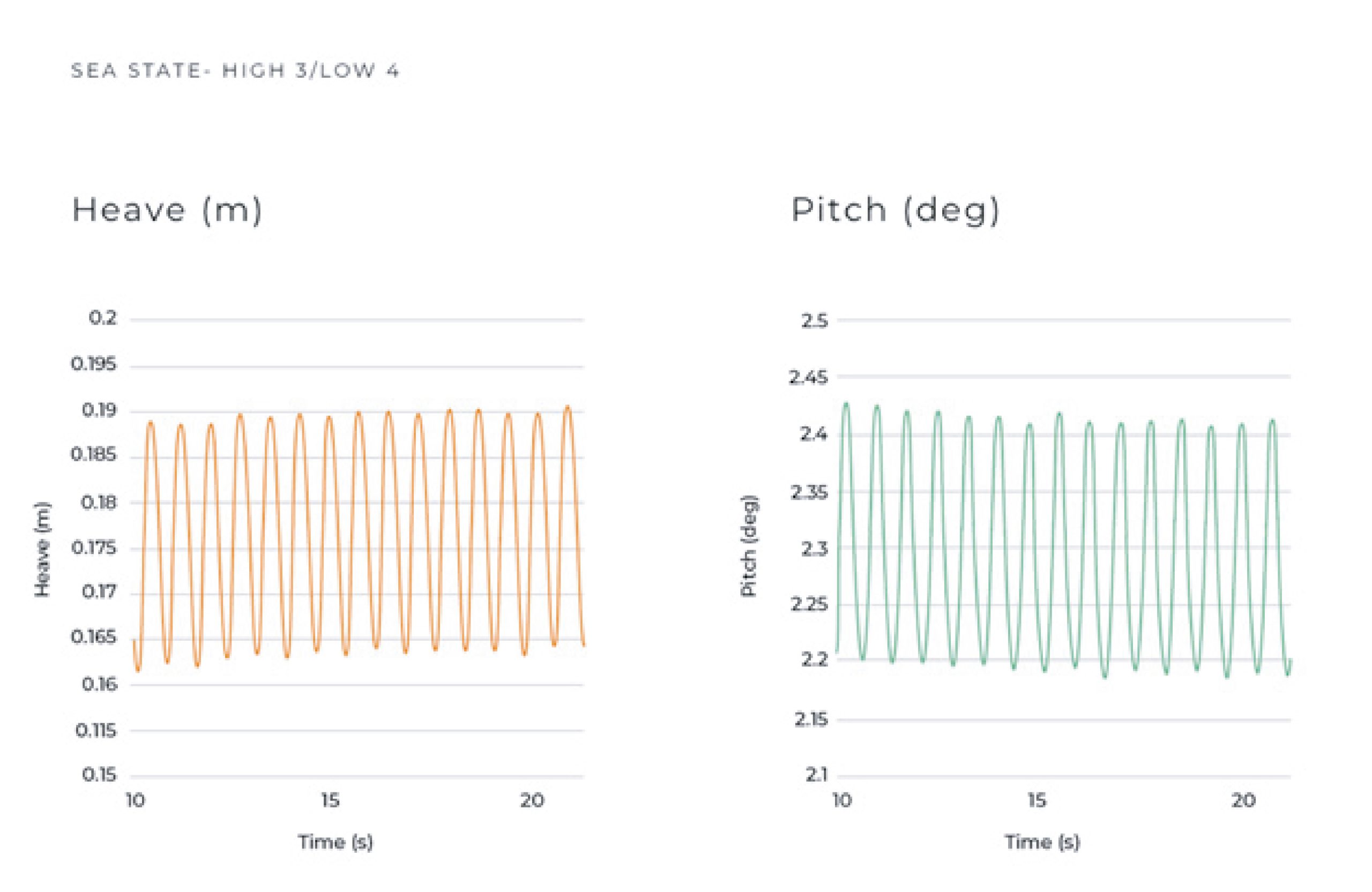
The Xiren platform will be able to travel at 30 knots in 1.5m – 2m chop and its pitch, that is its rocking motion, will be roughly 0.2 degrees and its heave, that is its up and down motion, will peak at 45cm but maintain 25cm on average. By comparison an identically sized catamaran will maintain an average heave of 80cm, peaking as high as 1.6m and a crew supply monohull will maintain an average heave of 60cm, peaking as high as 1.2m.

Neither a catamaran nor a monohull can maintain speeds close to 30 knots in such sea conditions. They would slam from wave to wave and near enough come to a dead stop. The Xiren will be able to maintain speed and stability at these speeds with little to no impact on comfort.

our yachts
These graphs display how the hull form performs in waves, more specifically a Sea State high 3/low sea state 4 with a regular wave of 1.5-2m wave height and 15m wavelength. The main results to extract are from the heave and pitch graphs. The amplitude of the graphs (distance from peak to trough) are extremely small. The heaving motion of the craft only varies by approximately 0.025m (25cm), whilst pitch angle varies by around 0.2°. This indicates an extremely stable platform at 30 knots in SS3/SS4.

James Blackmore
Engineer, Griffon Hovercraft

upto

0 %

more fuel-efficient than a wave-piercing monohull.

upto

0 %

more fuel efficient than a hard chine catamaran.

upto

0 %

more fuel-efficient than a wave-piercing catamaran.

“The comparative reduction in drag provided by the Xiren platform is significant. The hard chine catamaran equivalent would require double the horsepower to reach the same speed. A wave piercing, ‘best in class’ catamaran would require upwards of 20% more horsepower to reach the same speed and a monohull, up to 55% more. These figures directly correspond to fuel consumption and the comparative fuel saving provided by the Xiren hull form when compared to both catamarans and monohulled platforms is maintained at higher sea states.

Xiren will be able to maintain speed in higher sea state with less acceleration and slamming, making it significantly more economical, substantially more comfortable to passengers and without doubt kinder to censors and mission systems.”